


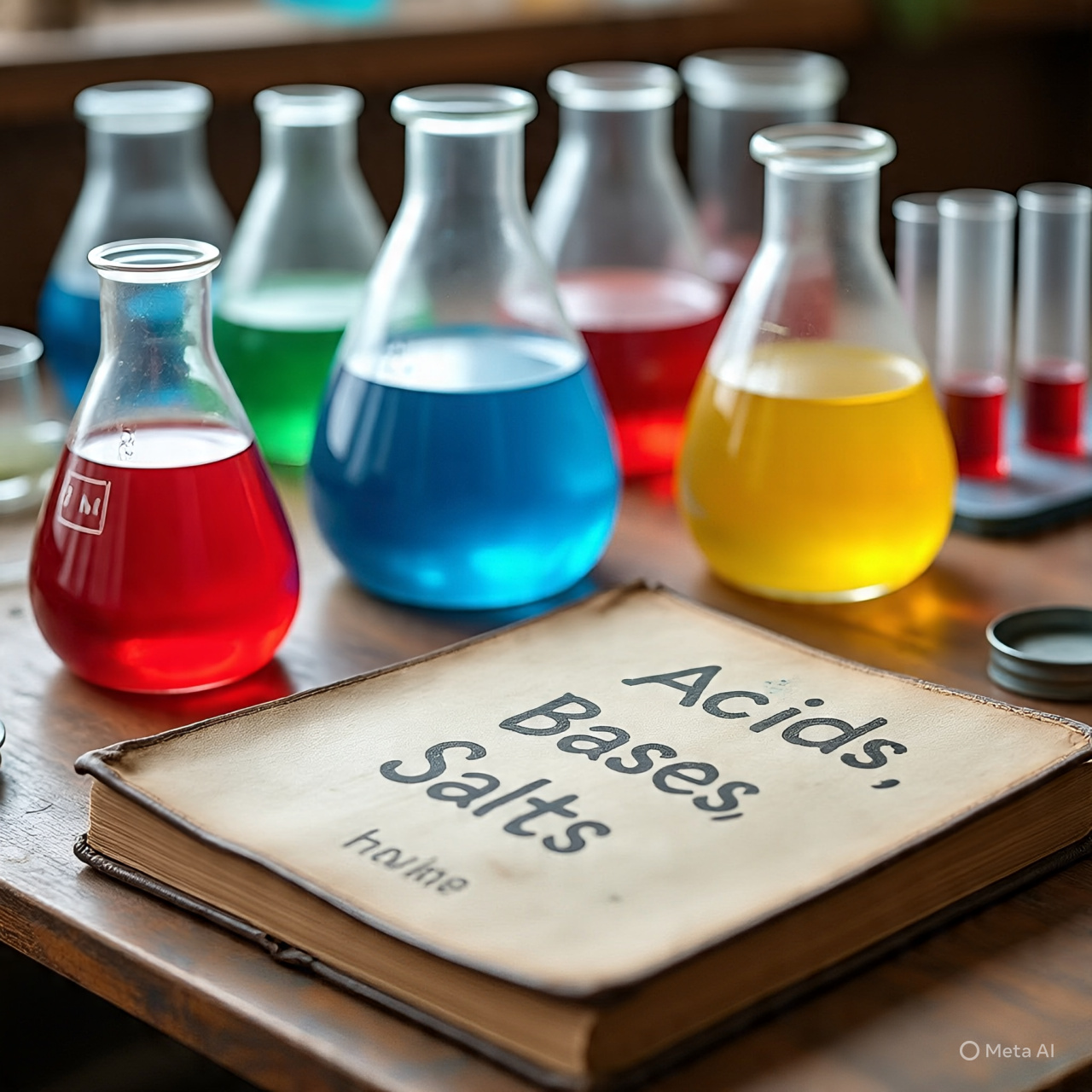
Chapter: Acids, Bases, and Salts
Introduction
Acids, bases, and salts are fundamental concepts in chemistry that play crucial roles in various chemical reactions and our daily lives. Understanding their properties and reactions is essential for comprehending many natural and industrial processes.
Acids
Definition and Properties
- Acids are substances that donate H+ ions in aqueous solutions.
- They have a sour taste and turn blue litmus paper red.
- Examples include hydrochloric acid (HCl), sulfuric acid (H2SO4), and acetic acid (CH3COOH).
Types of Acids
- Strong Acids: Completely ionize in water, e.g., HCl, H2SO4.
- Weak Acids: Partially ionize in water, e.g., CH3COOH, citric acid.
Bases
Definition and Properties
- Bases are substances that donate OH- ions in aqueous solutions.
- They have a bitter taste, feel soapy, and turn red litmus paper blue.
- Examples include sodium hydroxide (NaOH), calcium hydroxide (Ca(OH)2), and magnesium hydroxide (Mg(OH)2).
Types of Bases
- Strong Bases: Completely ionize in water, e.g., NaOH, KOH.
- Weak Bases: Partially ionize in water, e.g., NH4OH, Ca(OH)2.
pH Scale
- The pH scale measures the acidity or basicity of a solution, ranging from 0 to 14.
- pH 7 is neutral (neither acidic nor basic).
- pH < 7 is acidic, and pH > 7 is basic.
Chemical Properties of Acids and Bases
Reactions with Metals
- Acids react with metals to produce hydrogen gas and a salt.
- Example: Zn + 2HCl → ZnCl2 + H2
Reactions with Metal Carbonates and Bicarbonates
- Acids react with metal carbonates and bicarbonates to produce carbon dioxide, water, and a salt.
- Examples:
- Na2CO3 + 2HCl → 2NaCl + H2O + CO2
- NaHCO3 + HCl → NaCl + H2O + CO2
Neutralization Reactions
- Acids react with bases to form salt and water.
- Example: HCl + NaOH → NaCl + H2O
Salts
Definition and Types
- Salts are ionic compounds formed by the neutralization reaction of acids and bases.
- Types of salts:
- Normal Salts: Formed by the complete neutralization of an acid by a base, e.g., NaCl, K2SO4.
- Acid Salts: Formed by the partial neutralization of an acid by a base, e.g., NaHCO3, KHSO4.
- Basic Salts: Formed by the partial neutralization of a base by an acid, e.g., Zn(OH)Cl.
Uses of Acids, Bases, and Salts
- Acids: Used in industries (e.g., HCl in food processing), cleaning (e.g., HCl for toilet bowl cleaners), and medicine (e.g., antacids contain weak acids or bases).
- Bases: Used in industries (e.g., NaOH in soap manufacturing), cleaning (e.g., drain cleaners), and medicine (e.g., Mg(OH)2 in antacids).
- Salts: Used in food preservation (e.g., NaCl), medicine (e.g., saline solutions), and various industrial processes.
Conclusion
Acids, bases, and salts are vital components of chemistry with diverse applications in daily life and industries. Understanding their properties and reactions is crucial for various scientific and practical purposes.


